


The oldest professions 4
Kolodezniki
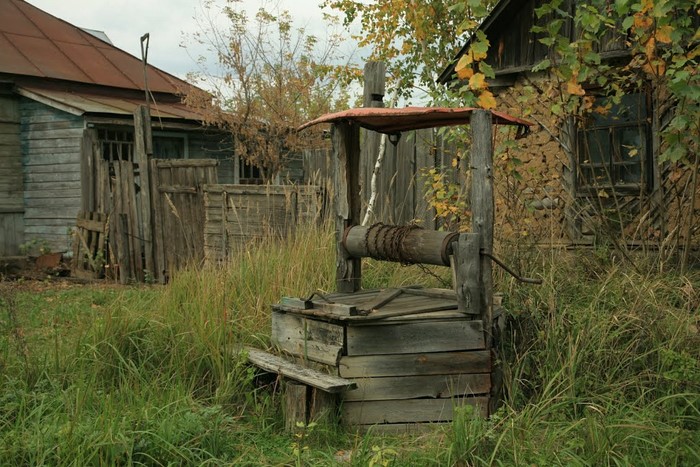
From time immemorial our ancestors scooped water directly from the river or a stream if those proceeded close. Used more often, applying state terminology, mine wells with wooden fellings. Masters of well business at first made a felling of bars of strong breeds, carefully banishing separate links. Links of a felling were consistently mounted in previously dug hole. Often the well was constructed together on border of possession of two adjacent neighbors. In these parts in more remote place served as the integral accessory of a well high "журавель" by means of which of depth of a well water got. Later and convenient application of a collar with a chain became more fashionable. Only in the thirties traditional wooden fellings gave way to concrete rings.
Gontari
Relatively not so long ago Kobrin roofs were covered gonty, straw, is more rare the neozinced tin. And here K. Paustovsky who visited Kobrin in war of 1915 remembered that roofs in the center were tile. On roofs it was possible to judge prosperity of the house owner to some extent. Gontovshchiki, or gontar, on special machines cut from aspen, thin plates of gont with a narrow groove in reinforced part are more rare than fir-tree bars. They quite often covered even brick houses. From thirtieth years the city administration forbade gonta, recommending in exchange roofing felt, roofing material and a galvanized tin which for many builders was too expensive. It is remarkable that the first mention of gonta for the Kobrin lock goes back to the end of the sixteenth century. Now the ancient craft is so thoroughly forgotten that the museum of A. V. Suvorov hardly got in due time a few gont for overlapping of part of a roof.
Strekhari
From an extreme antiquity our remote ancestors out of any competition had straw roofs, in local popular speech of "eaves". Not only for one and all economic structures, but also for houses. Separate links of eaves consisted of three - or four-articulate sandpipers – strongly connected straw bunches. For their production especially strong and long rye straw was selected. Despite the seeming primitiveness, "eaves" had a number of large advantages from which main – general availability and durability. Quite often primitive "eaves" endured sickly wooden fellings. The magnificent flakes of a green moss increased decades in some cases reliably protected straw from rotting. In heat the eaves gave a cool on an attic, and covered from overcooling in the winter. The last eaves tumble-down houses ceased to give an originality to our suburbs only in the last decades. It is pertinent to remember artificial revival of straw roofs recently in the West. For creation of a romantic aura and for the purpose of customer acquisition began to cover with straw small tourist hotels in Holland and some other countries.

Tryapichniki
Occasionally in a warm season on city streets there was a huge van to the full loaded with rags and other waste. It was the Jew a tryapichnik, on present terminology – mobile place of acceptance of utility refuse. At its emergence on the neighboring yards there was a noisy vanity. Hostesses with children took out earlier saved up rags and in eager rivalry tried to discover rags, unsuitable for the house use, and other second-hand articles in exchange for which it was possible to help out several small coins. This sort the goods were valuable raw materials for production of high-quality rag paper. However, tryapichnik did not disdain other any dobrishk: linking of newspapers, bottles, non-ferrous metal.
A. Martynov
Martynov, And. The oldest professions of Kobrin district / A. Martynov//Kobrin-inform. – 2011. – January 27. – Page 6.; Kobrynsk_ vesn_k. – 1995. – 18 studzenya.
Navigation

Our partners
Communication with us
Help: +375(1642)22331
Accommodation: +375(1642)39371
Excursions: +375(29)2046305
Support: +375(29)8012472
Email: atlant_kobrin@tut.by
Email: admin@ikobrin.ru
Edition: to contact us
To advertisers


About our city
For tourists
Our projects: Tourist Kobrin | Intellectual Kobrin
All rights reserved © 2011-2015. All images are protected by their owners.
When copying materials the active reference to http://ikobrin.ru is obligatory.