


Past professions
Time is relentless not only in relation to people. Some professions which representatives in due time in Kobrin district there was not so a little also consign to the irrevocable past.
RYMARI (SHORNIKI)
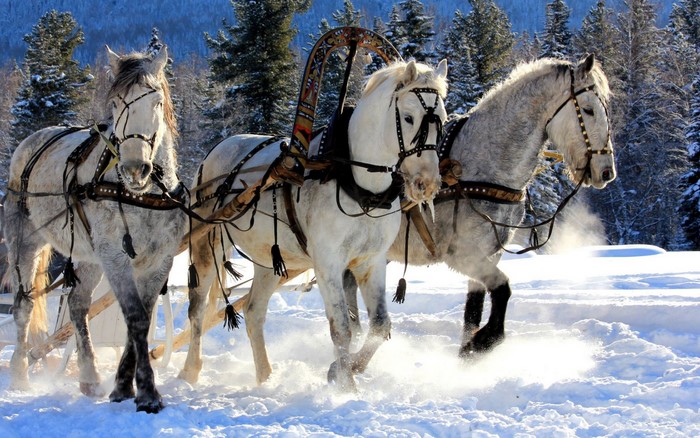
In memory still of the living generation at the very beginning of Brestskoy (Sovetskoy) Street several Jewish families went in for ancient craft of "rymar". They made a various leather horse harness, collars, bridles, tugs, cheressedelnik, etc. The most plain consumer goods, and goods by the special order, with intricate metal jewelry, plaques, asterisks, brushes were made. At the same time shornik were not only producers of the goods, but also sellers. Here it was possible to get the long tawing scourges of different function, and also wattled lashes for police. A wide choice of these quick-selling goods was in invariable demand as as the main draft force up to 50-60 years served horses.
HOUSE SERVANTS
Without exaggeration it is possible to claim that by the most widespread hired profession in pre-Soviet Kobrin it is necessary to call female house servants. According to 1897 in the city 283 servants were registered, even more they were before war. "Universalka" - servants on all hands was the most numerous kind of this profession. It was in full value of this word the right hand of the housewife for all occasions: to nurse juvenile children, to do washing, the cleaning and care of pets. In not numerous more well-founded houses the servants were divided into cooks and maids. Along with "stationary", constantly living in the house, servants became and coming, performing certain contractual tasks. Most often the servants were hired from among unfortunate rural teenagers of 13-18 years ready to work for the scantiest earnings. Many got accustomed in one family for the whole decade, and others preferred a nomadic way of life. As a rule, completely illiterate girls gained the first skills of reading and the letter from owners. Most often the further field of the matured girl broke a marriage.
PLOTOGONA
Half a century more back in use of our inhabitant the word "raftsmen" was widely used. This seasonal specialty gave additional earnings to a great number of peasants from the villages located near the river Mukhavets. The timber trade companies during a winter season brought from more remote woods of a log which after opening of the river got off in long rafts. After recession of a spring flood of a chain of rafts were alloyed downstream the rivers. It was necessary to do it in limited time to a river shallowing. The task of raftsmen consisted in supervision over a normal alloy. In case of need on abrupt turns by a long pole it was necessary to push away the brought rafts from the coast. On rafts primitive straw boxes for a lodging for the night and shelter from bad weather were constructed. On a lodging for the night rafts moored to the coast, raftsmen had a rest, cooking food at fires.
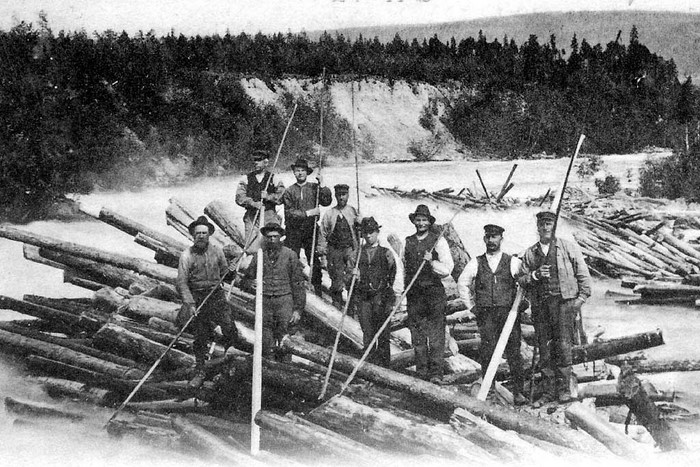
In Brest, at transition to Bug more abounding in water, two rafts connected in breadth, forming "полутафлю" which, in turn, at transition to Vistula was once again integrated already in the full-fledged "taflyu" consisting of four skhlestnuty initial rafts. Thus, the wood reached the destination most often through Gdansk to Europe. Raftsmen made all efforts for the fastest end of an alloy for the beginning of a haymaking.
A. Martynov
Martynov, And. Past professions / A. Martynov//Kobrin-inform. – 2010. – September 16. – Page 6.
Navigation

Our partners
Communication with us
Help: +375(1642)22331
Accommodation: +375(1642)39371
Excursions: +375(29)2046305
Support: +375(29)8012472
Email: atlant_kobrin@tut.by
Email: admin@ikobrin.ru
Edition: to contact us
To advertisers


About our city
For tourists
Our projects: Tourist Kobrin | Intellectual Kobrin
All rights reserved © 2011-2015. All images are protected by their owners.
When copying materials the active reference to http://ikobrin.ru is obligatory.