


Past professions
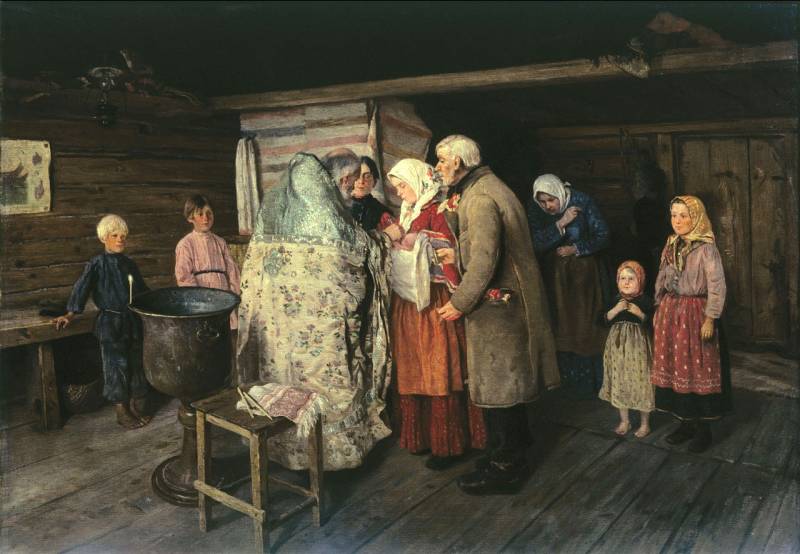
MIDWIVES. Believe it or not, but according to official statistical data of the beginning of the expiring century one professional midwife practiced in the Kobrin County with the population of 180 thousand. Naturally, the circle of its activity was extremely limited and was practically reduced to city line. From time immemorial the numerous and highly experienced grandmas midwives who for life were active in so profitable field in the city and the village were engaged in obstetrical activity. As they traditionally ignored the concept "antiseptics sterility", consequences of their naiveté affected high percent of mortal outcomes for women in labor, not to mention huge death of newborns.
KOZhUShNIKI. In not so still the remote past the rare profession of the kozhushnik wandering from the house to the house enjoyed wide popularity of country people. Usually during the winter period they were engaged in tailoring in the house of the customer of a universal winter attire. From time immemorial in Kobrin district sheep breeding was widespread therefore for casings there were enough a lot of local raw materials. Once casings were sewed mainly from not tanned sheepskins which were forced out subsequently by processed. At the beginning of this century quite often families of city petty bourgeoises used services of vagrant kozhushnik.
FACTORS. Need of this profession the becoming complicated life prompted everything. A long time the old weak-sighted Jew who was constantly rushing about on the city was the main city factor, settling "deals" of the many-sided clients. Not one intermediary office could envy the range of its activity. In case of need persons interested to replace or employ servants addressed assistance of a factor. On the other hand the pretender to this work acted. It was necessary to consider thinly inquiries and interests of the parties, to settle the conflicts. Its competence included also service of the house owners who are looking for nice lodgers is equal as needing certain "living space", that is the apartment. Efforts of a factor were paid with the commission charges arriving on both sides. This oberfaktor, naturally, had many puny competitors who enjoyed not such popularity.
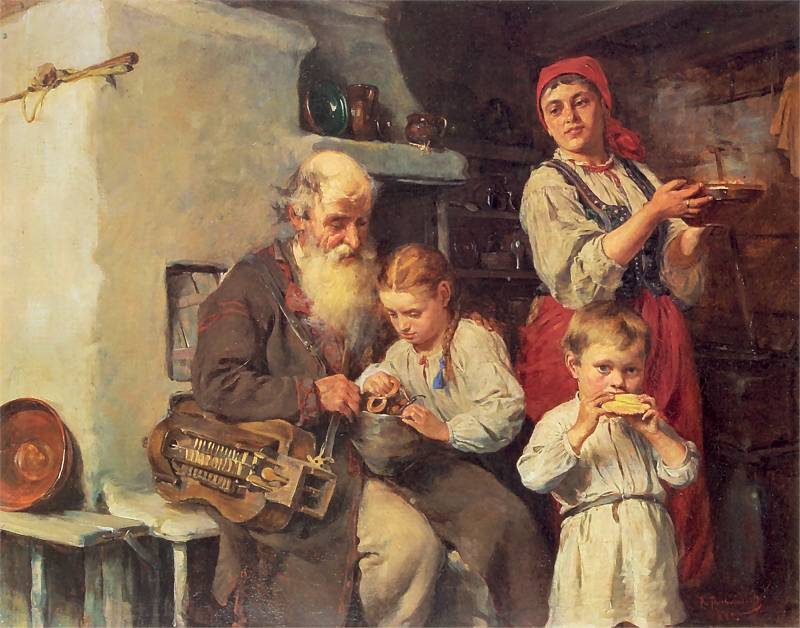
LIRNIKI. Undoubtedly, many readers though by hearsay knows the Greek name of the most ancient string musical instrument — lira. And here the subsequent modification of lira which became the widespread national tool of Ukrainians and Belarusians at us is already thoroughly forgotten. And half a century more back at Kobrin fairs it was possible to see and hear lapotnikov-lirnik quite often. There were it mainly poor blind men acting accompanied by the boy guide. The wooden lira which was bearing a faint resemblance to a violin in a form made creaking sounds at rotation of the handle. Under its sad accompaniment the lirnik sang songs of spiritual and moralising contents. Quite often the gentle children's voice of the guide was interwoven into his voice. Today the original lira can be seen unless only in museum of local lore.
HOUSE DRESSMAKERS. Wealthy people — usually those at us were successful landowners — employed the house dressmaker for long time. Usually unmarried skilled worker lived at customers not only many months, but happened also years. As a rule, the versatile specialist, to a certain extent even the versatile person in the business was selected. Updating of ladies' toilets, an age pereshivaniye of a kidswear belonged to its duties, and the remained time was devoted to tailoring of linen for all family members. It is explained by the fact that earlier on sale there was no such abundance and a variety of finished goods what appeared in the last decades.
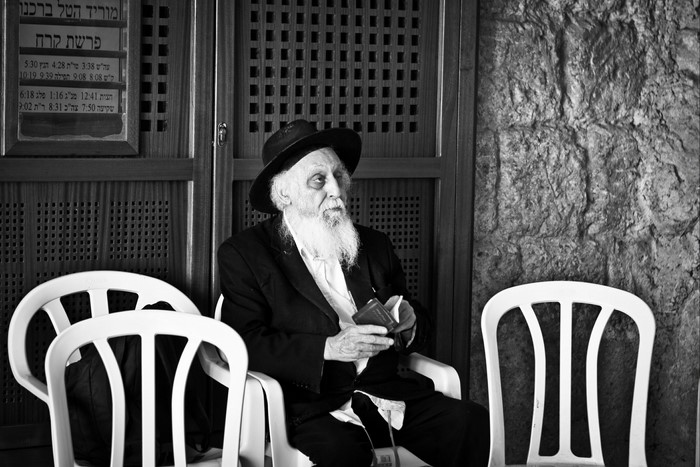
RABBI. So the Judaic priest dressed usually in a long-skirted frock coat and a black round hat was called. Its sedate dolgoborody figure on the street along with curiosity caused involuntary respect. In Kobryna from the middle of the past century there was the Jewish central temple — a synagogue, similar to an orthodox cathedral. The chief rabbi was a prior that corresponded to the Orthodox Christian decent. Besides, in different places of the city and in places there were many houses of worship, equivalent to parish churches. The rabbi a rank was at the head of everyone below. With Saturday church services the rabbi was helped by the cantor-chorister. In a synagogue of the man there had to be with the covered head, women surely in scarfs. Obliged also the most strict division of floors. Besides departure of ritual services, the rabbi was the categorical judge to whom the parties applied for permission of the household conflicts. Widely the familiar expression in difficult cases flitted: "To go to Rabin". He will understand.
GITsELI. Periodically on city streets there was an original vehicle with a long box which walls are tightened by a grid. At the sight of its young and old alike knew: gitsel arrived — catching of stray dogs is necessary. Gitseli, differently rip-offs, applied to catching of neutral dogs a long stick with a loop on the end, such our lasso. The caught razyava did not manage to come round as ended up behind the bars in the company of similar suicide bombers. Naturally, fell into a trap not only homeless dogs, in case of disappearance of a master's mongrel after attack of rip-offs owners knew where to look for loss. For contractual repayment the property of the owner came back to a native farmstead. At the sight of huge packs of stray dogs which divorced excessively now there is a regret that the profession gitselya unfairly and prematurely got to an assembly of disappeared...

DEALERS. In market and especially in exhibition days on the remote approaches to the city since early morning there were bright swells the Jews waiting lonely peasants with testicles, oil, living creatures and other good. Having caught sight of the victim, the picketer without ceremonies snatched out loaded baskets from hands of the stunned woman, suggesting to wholesale all contents. Naturally, on quotations, favorable to the robber. Attempts of resistance and the woman's cries seldom frightened off the dealer. To fool the skilled psychologist, the master by fine words, usually it was possible to find with injured the common language allowing to earn additionally to kids on molochishko. It is the most interesting that such trade was considered as quite lawful.

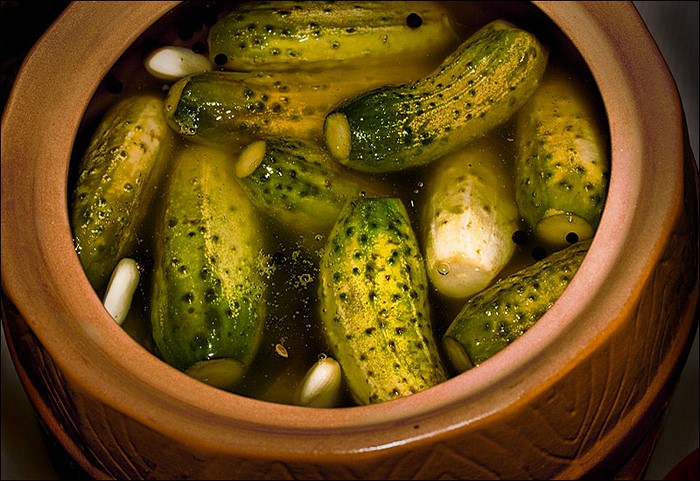
OGUREChNITsY. On fields of part over the river of the city in pre-war years the Jewish plantations of cucumbers at which poor petty-bourgeois girls worked as day-labourers prospered. And unlike the present fashion which is fond of the southern suntan, the fashion of that time dictated a languid whiteness of a face. It was reached without use of antediluvian whitewash — a simple zakutyvaniye of the person by a scarf with a gleam for eyes. It is unlikely these ogurechnitsa deserve to get to a collection former if not one juicy detail. Suddenly it was found out that the American gourmets blazed with passion to exotic Kobrin cucumbers with which barrels regularly crossed for a number of years through Atlantic. And the solution consisted that in cucumber barrels were located carefully disguised on both sides by ranks of cucumbers, cans with top-quality domestic alcohol. There was this at the height of the Prohibition dominating in the USA forbidding trade in alcohol. Really, necessity is the mother of invention!
BOOKBINDERS. Today, when the majority of book production goes on sale swaddled in cover, is hardly believed that became so relative recently. Earlier to the majority of running literature on reader's shelves, including to textbooks, for safety it was necessary to pass through embraces of a vice of bookbinders surely. Standard covers needed to be pasted over with "marble" paper with stains. Whereas editions, more valuable to the owner, received strong linen vestments. Wealthy bibliophiles were fond of refined covers with a gold stamping, with a gilded sawn-off shotgun. Nowadays this profession with centuries-old tradition degenerated and serves only important archival documents intended for long storage.
REZNIKI. Once at a city slaughterhouse Jewish butchers surely were active. Their functions included ritual slaughter of cattle on Torah precepts which was made at one stroke a knife or the axe. Only such meat was considered kosher and suitable in food of devout Jews. Otherwise meat became trefny and intended for goyev-gentiles. Official butchers were competed by the second-grade reznik practicing in the thick of the Jewish accommodation, so to speak. Addressed them for slaughter of a bird, sheep and other melochishka. In a prewartime the freethinkers daring to break century foundations occurred among the Jewish intellectuals without doing a difference between trefny and kosher more and more. Struck them that the tribespeople who arrived from east areas in 1939 for decades of the Soviet persecution on religion managed to remain faithful to precepts of ancestors in the relation koshernog and trefny.
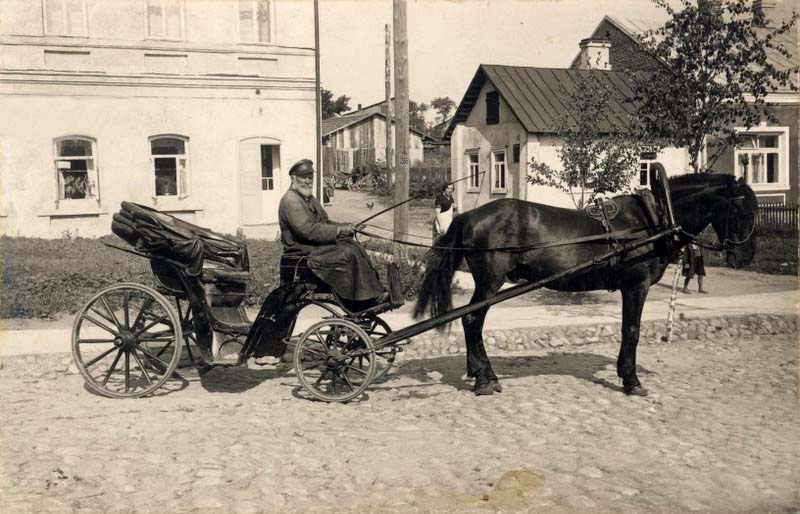
KUCERA. In not so the remote Kobrin dared to have the personal driver, partly for prestigious reasons, successful businessmen, it is equal as prominent officials of district scale whose activity demanded frequent traveling on the huge county — from Ivanov to Zhabinka — and therefore exit horses with the driver were paid at public expense. On our representations, the position of the driver is equivalent to "the personal driver". Incomparably more professional drivers were available in a service of the rich landowners holding both output, and saddle horses. Care of the horses consisting on their care and the maintenance in good repair of crews belonged to duties of drivers. Well, and, above all — to bring the sir where the team will follow.
BULOChNITsY, MILKWOMEN. Since early morning and in the forenoon, in heat and a blizzard it was possible to meet these elderly thickset Jews, with strain dragging on hands 2 huge baskets with appetizing production. What in them was only not: French rolls, challahs, croissants, steering-wheels, various fancy bread. And all this with a heat - about a heat, more hotly. Thus production of bakeries was regularly delivered to the house to a certain circle of regular customers. Usually goods were sold on credit with calculation in the persuaded time. With not smaller success the wandering milkwomen served wealthy clients. In the morning they filled portable cans with the pair milk acquired from owners of Burenkas. Purchase price — 8 pennies for quart, selling — 12. And difficult work.
STOLOVNIKI. In this case the elderly widows renting rooms to lonely employees most often were engaged in subsidiary earnings. Ordinary two-three more bachelors approached own lodger. The prompt housewife with pleasure showed the culinary art on production of tasty and nourishing lunches for much more reasonable prices, than in the dining room and furthermore restaurant. Skillful cooks enjoyed wide popularity. Between them quite often there was a burning competition, everyone tried to beat off more nice stolovnik. It was not accepted to raise a tax on such activity during that time
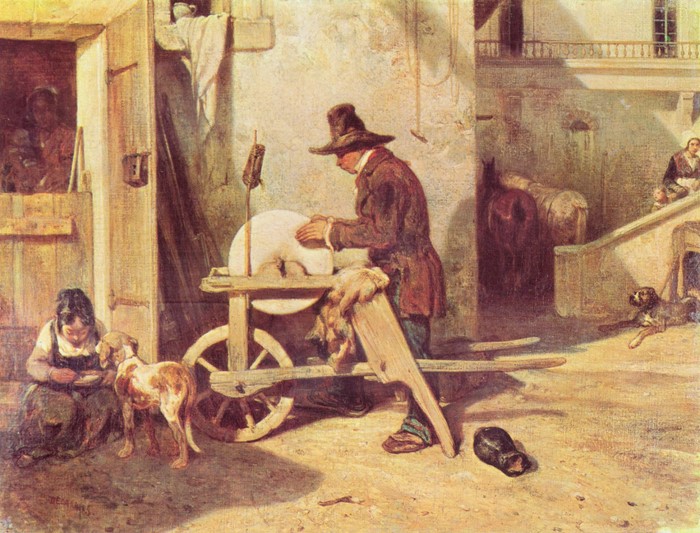
GRINDER. "Sharpen, sharpen knives, scissors!" it was carried from time to time on city streets. Thus the grinder's figure hunched under weight of the machine notified on the emergence. The thickset good-natured Jew, the original virtuoso in the business went in for this craft at us. Near it at once there was a turn. The range of orders was rather impressive, since completely the blunted axe to a knife from the meat grinder. Rhythmically pressing foot pedals, with jokes and humourous catchphrases the master quickly sharpened the brought pieces of iron soundly and cheap. Isn't that so, how annoyingly what the so necessary craft in life does not revive?
VYVESOChNIKI. Alas, again it is necessary to apply again trivial "in the recent past". The widest people at large got acquainted with elements of the fine arts on the central streets speckled by variegated signs. Where there before those inspired vyvesochny affairs of masters to present imitators, creators of the substitute stained-glass windows dashingly painting shop-fronts with heartless geometrical puzzles. Reckoning with huge percent of full illiteracy of the population, in this type of advertizing not the text, but the image should play the taking priority role. Without philosophizing crafty, the sign had to declare at first sight brightly, "who is who". On a small piece of a tin in ultraprimitivism manner the artist was given an opportunity to give full vent to the creative imagination. Therefore, a little reminding nature, a grain loaf, the French roll and a linking of steering-wheels on one sign had something in common with the horse attractive face tightened in a homutny corset — on next. Various types of hours, schematic rolls of bright fabrics, and nearby — crafty smiling beauty's head bordered with gaping scissors and curling tongs insistently attracted the passerby to cross a hairdressing salon threshold. Joiner's and metalwork tools, headdresses, ware, footwear, clothes, paper stationery products — all this in pseudorealistic execution pleased looks of passersby, giving a unique originality to trade advertizing.
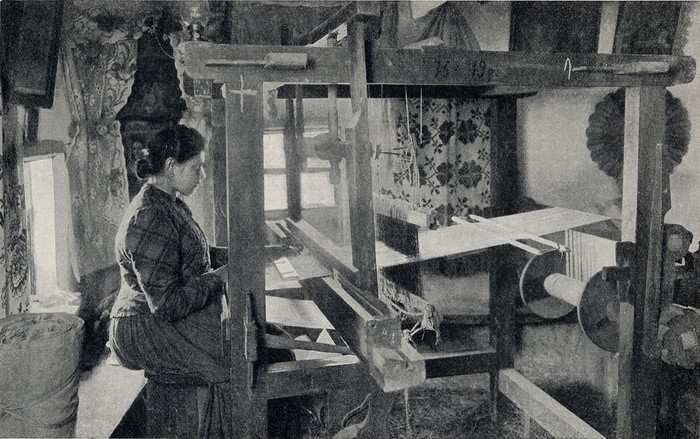
SPINNERS are WEAVERS. Who could think now that else before evacuation of kobrinets in a year 1915 in petty-bourgeois families in the general use there was a linen sewed from a homespun canvas of own production? Meanwhile on petty-bourgeois suburban strips it was annually grown up lyon which then passed through all stages of manual processing. Sound kudelya it was spun on the cooing spinning wheel (a kolovrotka, local), dispersing boredom of infinite autumn and winter evenings. Then, usually in preeaster weeks, one of close rooms of the petty-bourgeois apartment was encumbered with the self-made weaving loom behind which the hostess giving the skill to daughters tirelessly conjured. Besides a usual cloth, from the machine intricate figured towels, cloths, paths were exhausted. The part of annual production came to antiquated chests, accumulating a dowry for daughters. After use of a stock of threads the machine understood and rested in bed till the next season.
SHOEMAKERS. If column JI. To N. Tolstoy who in the evening of life plaid about a tachaniye of boots, told that already then the decline of this drevnyushchy craft was distinctly looked through, he, undoubtedly, would consider it for a joke. Meanwhile, at the beginning of the century cars began to produce more and more standard footwear. Before mass production of factory footwear captivated trade counters, in Kobrin and in a set of settlements subordinated to it assemblies of shoemakers slaved away. In the city there were several small workshops with 3-4 hired workers. Most of shoemakers carried out orders at themselves at home. And only a small number of original experts were engaged in tailoring of high-quality footwear for exacting customers. Whereas the others sewed rough working boots and the same quality women's boots. Let's remember that all shoemakers depended on makers who carried out an initial stage of division of labor — open skin and primary tailoring of details.
MATSA, BANKUH. In rather already bothered past in the city the culinary specialists seasonal workers connected with the Jewish holidays Side curls and Easter at the same time were active. So to speak, different sides of the same coin. And, if Jews in something limited the usual menu on holidays, then Christians of all religions, on the contrary, exercised the wit in preparation of especially delicious, compare, however. During a number of the weeks preceding Peysakh the extraordinary revival in a set of the Jewish families caused by need to bake mountains of matzo reigned. These thin square flat cakes from not fermented test were used by devout Jews in festive weeks instead of bread. As in limited time it was necessary to make matzo tons, no bakery would cope with such task. Therefore in private houses cash Russian furnaces "were mobilized". A great lot of volunteers who, trying very much and working serially was involved in this pious business, nevertheless coped in time.
A here that occurred at Christian antipodes in holiday weeks. In more well-founded houses also began the activities of the skilled worker for baking of a crown delicacy of a holiday table — a baumkukhen, at us simply crowned bankukhy. Difficult procedure of its production deserves an odovospevaniye. On a zagnetka of the Russian furnace the layer heated wood ugolyev evenly extended. Over them the zhestyany hollow cylinder of a special design which slowly rotated manually was located on two support. On the warmed cylinder consistently, a layer behind a layer thinnish superfancy pastry which was reddened from all directions was poured. At the same time on all surface there were pimples which are extended with each layer. In a final outcome of archin height the rich construction justified the German name — a tree cake, a set of cones reminded boughs. The successful baking of a bankukh demanded from the skilled worker of big ability and work and respectively was well paid. On an easter table bankukh, topped with a sugar lamb, reigned over a set of delicious viands as an unsurpassed masterpiece for festive gluttony.
POSTOLY-SERMYaGI. It would be inexcusable to ignore in end of this fluent review of the professions which fell into oblivion suddenly the disappeared traditional country clothes of Kobrin district. And on it long since it was possible to distinguish the peasant from the citizen unmistakably. However, separate objects, including bast shoes, were widely applied in life even in the fiftieth. As for the 20-30th, in holidays all hillock of city Peter and Paul church reminded huge pack of geese swans. Such impression was made by the mass of peasants in the invariable white attires. From time immemorial the homespun white cloth was the only fabric not only on tailoring of underwear, but also summer outerwear both man's, and female. Even daily top shirts and female fartukh did not do without modest color jewelry. Not to mention the festive clothes which are richly adorned with an embroidery with prevalence of red and black coloring. Homespun woolen andarak were also pleasing to the eye harmonious raznotsvety. Special magnificence — I will not be afraid of such grandiloquence — festive headdresses of elderly women from especially thin canvas differed. Most difficult twisted around the head a namitka-towel from 2 to 5 meters long, came to an end spread on a back by a platom-cloak, making impression of a solemn originality. The top summer clothes consisted of a daily sermyaga more rough white, sometimes reddish, cloth. And here festive tonkosukonny a roll it was decorated on seams and pockets with an intricate embroidery with motley brushes. As indispensable accessory of outerwear served homespun narrow passes belts of bright coloring. Whereas multi-colored hustki-scarfs and hustynka were female headdresses, more solid winter scarfs, men carried straw kapelyukh, quite often own production, sometimes caps in the summer, sheepskin caps prevailed in the winter. During the winter period reliably protected a long-skirted casing from an icy cold. The youth preferred the shortened polukozhushka intricately embroidered on seams. Since ancient times lykovy postoly-bast shoes, mainly the work were the prevailing type of the rural obuvka which served up to a half of our century. Wearable in the winter and in the summer, with only that difference that onuchas footcloths were either cloth, or linen which in one and other option were hardly twisted with a long cord. And here valenoks owing to high cost were not in great demand. Not everyone was able to afford to bring time to lives leather boots-choboty. As a great value they could be descended. Were put on often only on near approaches to the city, made other way behind the back of the owner. Rural shchegolikh were dressed up in the simple Christmas laced boots with high tops. Remarkable feature: barefoot women surely swaddled shins zavoyka — long strips of a white cloth, neither to give — nor to take, soldier's windings. Such is in the most fluent review there was a standard attire of our countrymen almost to the second half of this century. Today, alas! only the few have an idea of it. The remained trifle occasionally rests in bed in antiquated chests. Who knows what rarity were original lykovy postola which were regularly serving to tens of disappeared generations now. The majority escaped a dobrishka stiffened in show-windows of museums of local lore.
"MONOPOLKA". By way of exception in a final note it will be a question not of the next disappeared profession, and of falsities of destinies to all citizens of a familiar complex of buildings of a red brick at the end of Sovetskaya Street. Once all of them in informal conversation united the sonorous word "monopole". When at the end of the XIX Art. in Russia the state monopoly for production and sale of vodka products was entered, all production of distilleries had to arrive on the centralized base for further rectification. At large manors of the Kobrin County many distilleries for which reception of production "monopole" was built worked. Crude alcohol was stored in extensive cellars of the central one-storeyed building and there were further operations on its processing in "forty-degree". Other houses intended for service personnel. In the tenth years of the XX St. spirits bases were abolished, and the complex of the monopole came to maintaining the Ministry of Public Education. Soon in the central building the four-cool city school was placed. In two adjacent — four-cool men's and women's parish schools. Other houses intended under teacher's apartments. In the mid-twenties the Polish administration decided to use the central building under a gymnasium which occupied two adjacent wooden houses on Traugutt (Suvorov) St. before. Significantly the proposal of the owner of a manor Grushevo, the popular Polish writer Maria Rodzevichuvna facilitated this task, to allocate considerable funds for a superstructure of the second floor. In gratitude for the shown generosity of a gymnasium the name of the donator was appropriated. The constant number of pupils of a paid gymnasium did not exceed 350-400. Since fall of 1939 the county's first SSh No. 1 was proved in this house, in it the number of pupils passed for 1200. In the first days of war of fatal 1941. here the field hospital for service of a great number of the Soviet wounded who were injured during fight at the neighboring canal of the Bond was translated from the next hospital. Soon the survived wounded were sent to Brest, and the building was occupied with the central body of the civil occupational power — gebitskomissariaty. After exile of invaders the building became a nursery reasonable, kind, eternal again...
A. Martynov
Martynov, And. Past professions / A. Martynov//Kobrin-inform. – 2010. – September 16. – Page 6.
Navigation

Our partners
Communication with us
Help: +375(1642)22331
Accommodation: +375(1642)39371
Excursions: +375(29)2046305
Support: +375(29)8012472
Email: atlant_kobrin@tut.by
Email: admin@ikobrin.ru
Edition: to contact us
To advertisers


About our city
For tourists
Our projects: Tourist Kobrin | Intellectual Kobrin
All rights reserved © 2011-2015. All images are protected by their owners.
When copying materials the active reference to http://ikobrin.ru is obligatory.