


The oldest professions 2
MILLERS
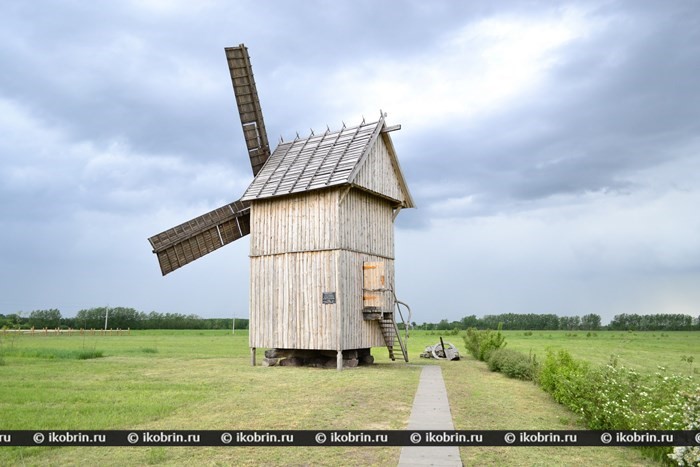
Once in windy weather on suburbs of the city of Kobrin day and night tirelessly numerous windmills swung gontovy wings. Over five hundred wind-driven generators was in the county at the beginning of the 20th century. Then they officially were called as "flour-grinding institutions". Still in the twenties one wind-driven generator rose on a sandy hillock at the end of Pinskaya (Pervomayskoy Street whereas on Sverdlov St. three regularly working mills stood in the row. For a grinding the contractual payment was raised by either cash, or nature in the form of a certain measure of grain. Our wind-driven generators depending on the direction of wind turned in the necessary party the whole case while in East Belarus only the top part was mobile. Finally wind-driven generators in the thirties when they were replaced by the first steam and flour-grinding enterprises disappeared. In more remote past in the city and the county there were many water-mills. One of them stood on the small river to the Lithuanian who during that time was incomparably more abounding in water. In thirty years near its mouth a number of the obomshely piles which remained from an old dam stuck out over water.
SAWYERS
The first mechanized sawmill arose in Kobrin in the first half of the twentieth years. Before all need of builders for boards and bars was completely satisfied with heavy manual sawing up of logs. Couple of trestle of two-meter height to which the log from above fastened were for this purpose applied. One sawyer balanced on a log, the second was under it. The special longitudinal saw which undressed a log on the equal strips which are beaten off by a prougolenny cord was applied to sawing up. Payment was made for running meter of finished goods. Such sawing up was applied at us still a long time in post-war years.
MAGYARS
How long it was... Suddenly from the house to the house the message rushes: Magyars arrived! It served as a signal that on this street the company of two-three swarty people in original sleeveless jackets with a set of buttons and in felt hats with coquettish plumelets appeared. These are transtvuyushchy, usually in the spring, Magyar Hungarians (called them and so, each in his own way), were engaged in a kastrirovaniye of animals. The ordered operation was made publicly, bringing together many talkative gapers. Procedure was usually made by a folding pocket knife, did without antiseptics and if applied it by way of exception, then the most primitive. These people enjoyed confidence and invariable success at petty bourgeoises, doing without the slightest costs of self-advertisement. After their leaving on farmsteads low unfairly of the offended dumb animals long did not cease.
ZONTICHNIKI
To imagine only - once in Kobrin there was a workshop on production and repair of umbrellas. Presently, when all objects used in life are made in large quantities, their cost is rather small therefore quite often quite suitable thing is with a light heart replaced with new. So was not always: to things, habitual in the past, treated with great respect. The tiny umbrella workshop with three workers most often was engaged in "maintenance" of the spoiled umbrella, mainly replacement of spokes and updating of fabric. However, did not meet refusal and those priverednik who would like to flaunt the special umbrella executed by the special order. The workshop had necessary details and therefore on lack of orders did not name.

SHEPHERDS
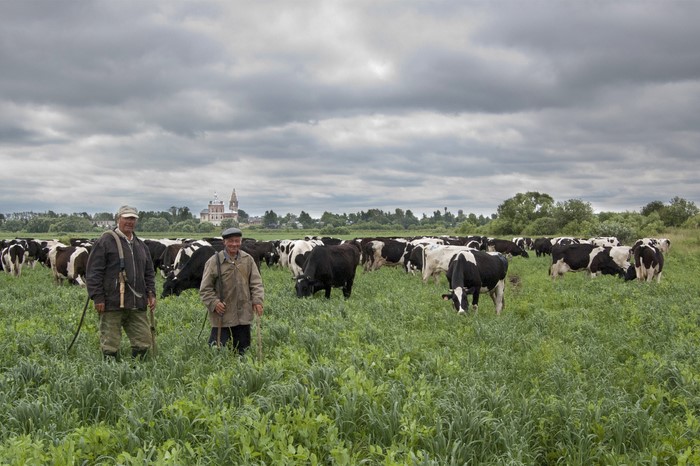
If pre-war Kobrin in something reminded the village, then first of all herds of cows who and disclosed in the morning low literally all city streets in the evening. Burenkas were held not only petty bourgeoises farmers, besides not on one. Much they were available for the needy Jews living in the downtown though for condition cattle breeding were not favorable there. Employment of the shepherd was carried out long before the beginning of a pasturable season. Spring Yury and autumn Mikhail was considered as traditional terms of the beginning and end of a pasture. For the hostess the first pasture of cows was the holiday. The consecrated willow was surely put on use. However, if weather favored, terms of a pasture lasted for day payment. Pasturage of cows by owners in turn in Kobrin was not known.
WOODCUTTERS
Quite often on city streets it was possible to meet the woodcutters who are in pairs wandering in job searches. Up to the middle of the twentieth years when the part of citizens began to apply coal to heating of furnaces, firewood was the only type of fuel. Served as their unit of measure till 1915 a shestukha and a vosmukha that corresponded to the sixth and eighth part of cubic sazhen. From warehouses firewood was usually released by meter length and was subject to sawing up. The firewood brought by peasants to market days usually was half shorter. Jews and employees were regular customers of woodcutters.
A. Martynov
Martynov, And. The oldest professions of Kobrin district; The Died and dying professions: history / A. Martynov//Kobrin-inform. – 2010. – October 14. – Page 6; Kobrynsk_ vesn_k. – 1995. – 14 studzenya.
Navigation

Our partners
Communication with us
Help: +375(1642)22331
Accommodation: +375(1642)39371
Excursions: +375(29)2046305
Support: +375(29)8012472
Email: atlant_kobrin@tut.by
Email: admin@ikobrin.ru
Edition: to contact us
To advertisers


About our city
For tourists
Our projects: Tourist Kobrin | Intellectual Kobrin
All rights reserved © 2011-2015. All images are protected by their owners.
When copying materials the active reference to http://ikobrin.ru is obligatory.