


The oldest professions
MEDNOLITEYNY BUSINESS. In the poor list of professions which fed some to the kobrinchena in the early twenties it appeared also such. It mainly served the Jewish population of the city and densely their brothers in faith living in large places. The main range of products consisted of the same ritual copper candlesticks. The matter is that in the evenings on Friday and Saturday these candlesticks with the lit candles, "shabasuvka", were located on windows of the Jewish apartments on one on each family member. Besides, in a workshop various other ware from tinned copper was manufactured: the pans, buckets, baking sheets which were also serving to the ritual purposes. Along with so-called Jewish specifics representatives of this not numerous profession were engaged in a tinning of samovars and enjoying wide popularity at citizens of copper pans, is equal as soldering business.
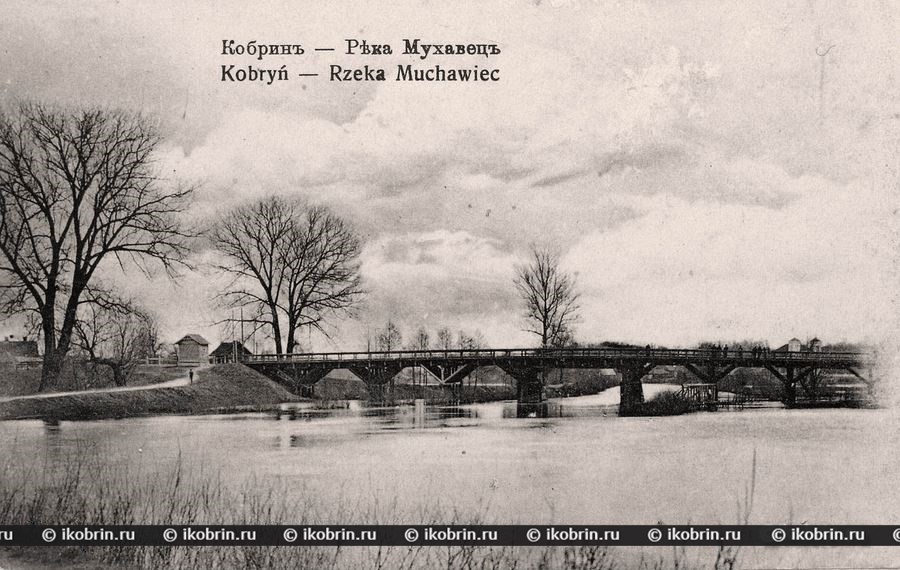
BOATMEN. Presently it is difficult even to imagine how present hopeless and sad smooth surface of native Mukhavts half a century more teemed with the flat-bottomed boats, fishing odnoderevka and especially multi-colored kayaks called at us by kayaks back. Besides that many citizens had personal swimming means, near the bridge the graceful wooden pavilion of Shimpel suggesting to fans to use a wide choice of boats and kayaks for small hourly payment rose. Naturally, solid boats and restless kayaks were not delivered to us, and produced on site by skilled boatmen and by individual orders. Inveterate kayakers often competed in races on a certain distance.
BRUKOVShchIKI. This word at us called experts, zamashchivayushchy streets a cobble-stone. By the way, still stones rather recently necessary for this purpose lay on fields in some places of Kobrin district much. Up to the middle of the 30th the overwhelming part of city streets was paved by so-called "cat's foreheads", that is roundish cobble-stones. Article on payment of seasonal crew of brukovshchik was provided in the estimate of the pre-war city budget. In a warm season expeditious elimination of hollows in a pavement, and also change of the broken sidewalk plates belonged to their duties. In the mid-thirties on several streets of the central part of the city outdated cobble-stones in the form of experience were replaced with the "trilinka", six-sided checkers made of mix of shredded granite with concrete. Only in later time of a trilinka were gradually asphalted.
HERALDS. Not without justification the author believes that at this word at the reader historical novels with descriptions are remembered as in old times on squares heralds, and in Russian heralds, announced imperial decrees, "It will be known and conducted yes to everyone..." This archaic profession in Kobrin endured the Middle Ages, revived and vegetated up to memorable September, 1939. An official person was the sedenky Jewish old man dressed in a long chlamys who cried out burning orders of city magistrate on suburban streets. This phenomenon by the fact that at full illiteracy of considerable part of citizens printing announcements were not perceived properly was explained, the distorted Polish, Russian, Jewish languages were used equally. In passing his talent was quite often used by the city slaughterhouse notifying the poor on the cheap beef which went on sale and a city bath about neither frequent, nor regular bathing day.
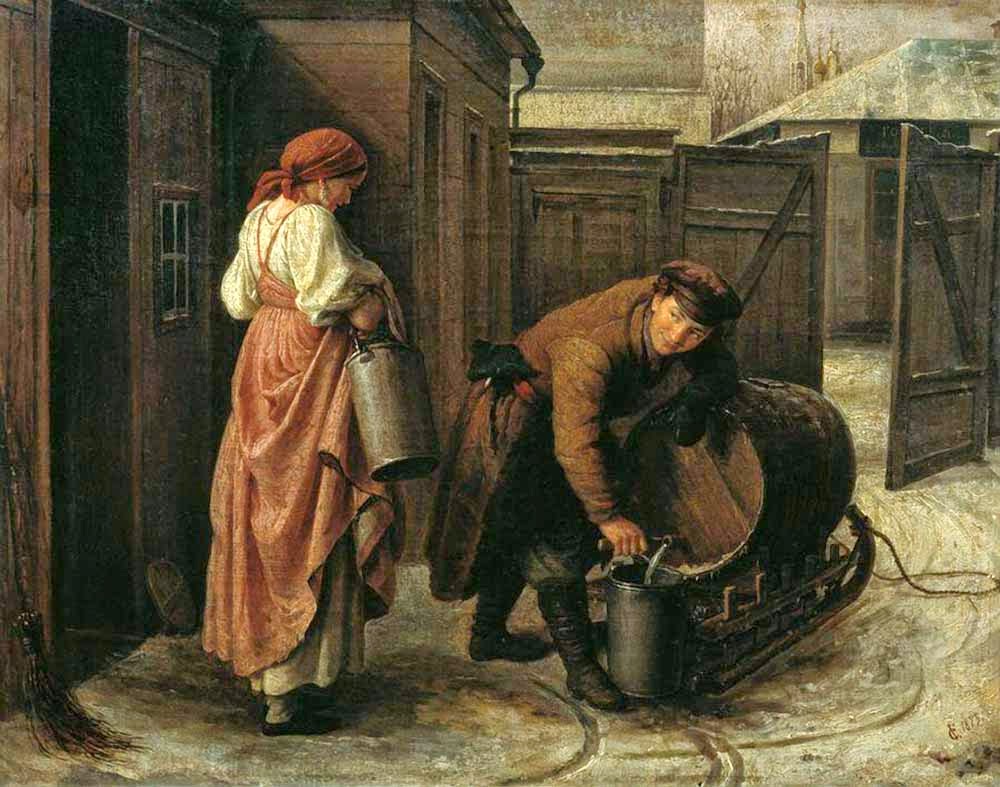
WATER CARRIERS. The inventory of municipal economy which is carried out after war found the curious phenomenon. Whereas on suburbs of "petty-bourgeois" streets abundance of mine wells is revealed, those almost completely were absent on the "Jewish" streets adjoining the Market square. On a card of the beginning of 20 Art. two huge wells under a high roof at the edges of this area are imprinted. Water from them was extracted by means of a collar with a big wooden wheel. Generally these wells served the peasants coming on a market with their pets. As for the population of adjacent houses, they preferred to use services of not numerous Jewish water carriers. Their supplies with wooden barrels all day long rumbled on a cobblestone road. Water was carried to clients on yokes, century that number on the second floors. This hard occupation was well paid. It is remarkable that the city health officer belonged it is indifferent to the fact that water was scooped directly from Mukhavts, and in the winter from an ice-hole. And barrels from time picturesquely acquired flakes of a green moss. Only in the twenties on the square the first artesian well of public use appeared.
CHIMNEY SWEEPS. These bright swarthy children often could be met on the central streets. For very moderate remuneration they dashingly climbed roofs, clearing chimney pipes of soot. Instruments of labor consisted of the round metal brush strengthened on a long rope with the weighty round weight attached on the end. However, most of owners of wooden houses with a straw roof did without services of chimney sweeps, clearing own flues fresh birch brooms. As soot collected enough, in order to avoid ignition and the possible fire according to the instruction this operation needed to be performed twice a year,
ZhERNOVShchIKI. Still quite often here and there it is possible to find the house manual mills thrown as superfluous called by millstones in sheds of city and rural old residents. Not especially widespread profession of a zhernovshchik was highly appreciated in the people. From field boulders of certain breeds the skilled master chisels formed two circles of equal diameter which for durability on a circle were fitted by hoops. Then notches on the one hand were applied on them. More massive lower millstone lay not movably whereas top rotating manually was easier. Pair millstones were located in the wooden machine of a standard design. Special adaptation the top stone out of need slightly rose or fell that allowed to receive torment of desirable grind. Especially widely millstones were applied to production of an osypka a pet. In addition the needy part of the population ground on millstones rough grain, especially yachny and buckwheat. Usually several neighbors used one millstones. It is difficult to overestimate that huge help which was given by millstones to many families of citizens in the years of occupation and during the long post-war period.
A. Martynov
Martynov, And. The oldest professions of Kobrin district; The Died and dying professions: history / A. Martynov//Kobrin-inform. – 2010. – October 14. – Page 6; Kobrynsk_ vesn_k. – 1995. – 14 studzenya.
Navigation

Our partners
Communication with us
Help: +375(1642)22331
Accommodation: +375(1642)39371
Excursions: +375(29)2046305
Support: +375(29)8012472
Email: atlant_kobrin@tut.by
Email: admin@ikobrin.ru
Edition: to contact us
To advertisers


About our city
For tourists
Our projects: Tourist Kobrin | Intellectual Kobrin
All rights reserved © 2011-2015. All images are protected by their owners.
When copying materials the active reference to http://ikobrin.ru is obligatory.