


What in your name, the street?
For the first time documentary data on streets of our city meet in "Audit of the Kobrin economy" made by Lev Sapegoy in 1563. Unfortunately, in the hand-written original of "Audit" which is stored in the Lithuanian historical archive the pages devoted to the description of a central square of Kobrin which from South side directly adjoined strengthenings of the defensive lock are lost. Presently ten streets originate from this area which from time immemorial was an original heart of the city. In official sources the area was called either Market, or Market. In 1939 it is renamed into Liberty Square.
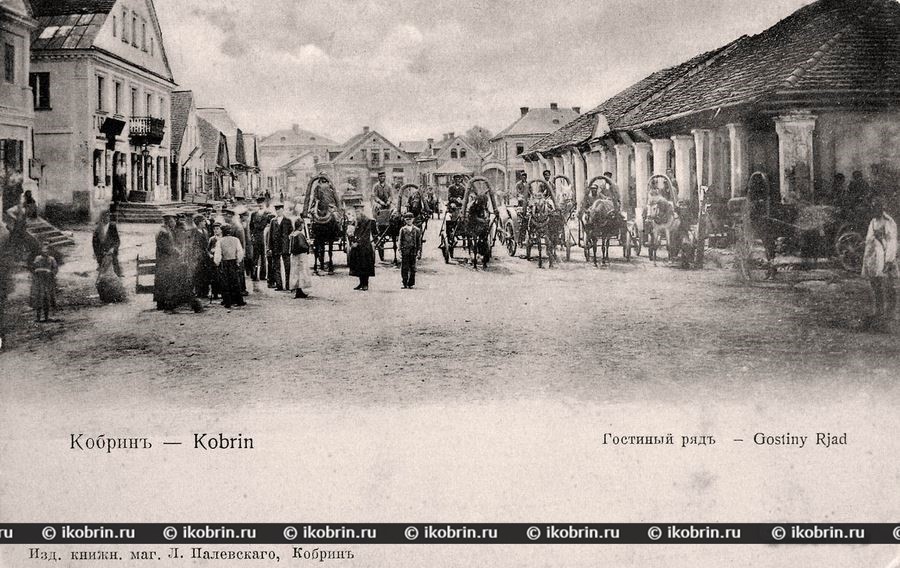
Speaking about names of streets, it is necessary to pay attention that already in the Middle Ages the kobrinchena, without philosophizing crafty, appropriated to streets names of those settlements in the direction of which streets lay. So, the recovered passable way which arose in immemorial times from Pinsk to Brest lay through Kobrin in the form of two streets extending parallel to Mukhavts's current. East part turned into Pinskaya Street. The Polish administration renamed it into the street on May 3, and since 1939 it became May Day. In the western direction continuation of this street in Audit is called as Cherevachitska, subsequently (apparently, after construction of the highway) began to be called Brest. Poles "christened" it to Legionov Street, named the Minister of Internal Affairs Peratsky killed by the revolutionary later. And in 1939 the modern name - Soviet was assigned to it.

In the southern direction from our main square Ratnenskaya Street stretched. At the next renaming of a number of city streets at the beginning of the twentieth century it was called Slavic that a little with a jeer as it was populated almost entirely with Jews sounded. However the revenge did not keep itself waiting long. In the thirty ninth year appropriated to the street a surname of the prominent Jewish writer Perets. But after war changed the name again - still she bears a name International. From the same southeast corner of the square one more small street gemmated. By way of exception anywhere not the leader. In Audit called extremely precisely - "the street over Kobrinka". Subsequently she was called Petty-bourgeois, Kobrinskoy, and the last half a century is known as October.

And, at last, on a left bank there is a fifth small street immortalized by Lev Sapegoy. Its name was exposed to the greatest changes. Branching off from Pinskaya, the street was in the beginning Bolotska as conducted to the village of the Bog. Later occupations of inhabitants - Bochkarskaya, Garbarsky (tanning), Factory were reflected in her names serially (when nearby there were handicraft brick zavodik). Due to the transfer on the next abolished cemetery of the ancient Peter and Paul church which was originally on the southern suburb of the Market square, the street called Peter and Paul. At Poles she became Polna, and in the 1939th the modern name - Red Army appeared.
The following data are borrowed from the plan of Kobrin made in 1798. Appears from it that for the past two centuries the city was replenished only with a small amount of the new streets which are still adjoining the center.
To the North from Market there was one more area - Castle. In the sixties the 19th century the orthodox cathedral was erected there, and in 1912 near it the building of landowner bank is built. Since then the square received a new name - Bank... If to follow from the bridge through Mukhavets, on the right it is necessary to list a chain of parallel streets. The first of them which was once bending around Zamkovaya square, Slushnaya (that is fair). It is renamed into Bazilianskaya later, and then into the street on September 17. Following it - River, subsequently renamed in Small swinish, in popular speech "Svinyache to a podrechya". Years later received the name Belarusian. Towards Soviet Sportivnaya Street at the end of which on the river coast the primitive stadium was located was bent.
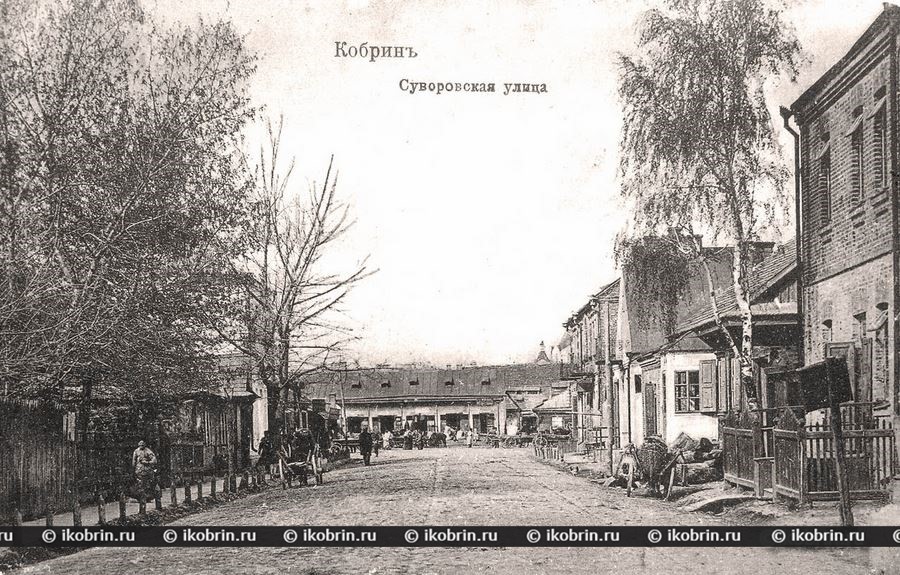
From the Market square in 1766 Gubernialnaya Street conducting to the estate of an administrative manor put on the city suburb the Province lay. When the manor took over Suvorova, the street began to bear a name of the commander. Poles changed the name in honor of Traugutt. However the name of Suvorov was restored besides in the 39th year. At the very end of of that time Suvorov modest Ogorodnitskaya, then Garden was formed. In the first post-war years when there was a present Lenin Square, the street received the name Pushkin.
In the twenties on the fields of a manor sold by the landowner Zelinsky the Province there were two cozy small streets which are built up with mansions of the Polish officials. This is Klopotsin renamed in Pioneer, and the Flower, become in 1939 st. of Zhdanov replaced later addressed to the marshal Zhukov. During the same period at the end of Pinskaya to the East from kostelny park Krasnogvardeyskaya Street was laid. Called it so because in the fall of the 39th the hostel of so-called Red Guard which kept in the city a public order to the organization of bodies of regular militia nearby was placed.
Repeated growth of the population was followed by intensive expansion of limits of Kobrin. Naturally, it involved the birth of new streets. Getting acquainted with the list of modern city streets, you test disappointment. To so serious question as assignment of a name to the street, at us belonged indifferently. The majority of names do not shine with originality and can, hardly, apply for safety in centuries...
A. Martynov
Martynov, And. What in your name, the street? / Alexey Martynov//Kobrynsk_ vesn_k. – 2002. – 27 l_penya.
Navigation

Our partners
Communication with us
Help: +375(1642)22331
Accommodation: +375(1642)39371
Excursions: +375(29)2046305
Support: +375(29)8012472
Email: atlant_kobrin@tut.by
Email: admin@ikobrin.ru
Edition: to contact us
To advertisers


About our city
For tourists
Our projects: Tourist Kobrin | Intellectual Kobrin
All rights reserved © 2011-2015. All images are protected by their owners.
When copying materials the active reference to http://ikobrin.ru is obligatory.