


Hello, horses!
At all times: and before formation of collective farms, and in the first several decades of existence of collective farms, at us on Belarus the country family and a country community stood on a working horse. That our power was also strong. But there was also time when forgot about a horse as the toiler at all. It was succeeded a tractor and the car. But at that time one liter of diesel fuel cost 7 kopeks. Then nobody inquired in collective farms when how many and from where delivered fuels and lubricants. Then buildings for the maintenance of cattle were under construction in the manner of palaces under the mechanized removal of manure and transportation of forages equipment, but not horses. Though not everywhere.
To me excursion at the beginning of the 80th in collective farm "Soviet Belarus" to well-known and then Bedule is remembered. All have an equipment, and it has horses. All have palaces for cattle, and it has wooden constructions. Having foreseen questions, it then told that "money should be counted". And at it cheaper, and contents according to animal physiology. Present a cow in the winter on a cement floor, and on a warm straw laying. Caught a difference? Life confirmed Beduli's correctness.
For today in different regions of Belarus various quantity of horses. For example: in the Stalin area on average on economy 103 horses, in Kobrinskom – 40. And in collective farms of Kobrin district, such as "Dawn" – 42 horses, of Dzerzhinsky – 153, of Kutuzov – 123, "Orekhovsky" – 18, sortoispytatelny station – 4. 4 horses and on all collective farm "Dneprobugsky". And at collective farmers on a personal farmstead who on collective farm 4, at other 204 workers have horses. And all weight of processing of personal plots lies on a working horse. There the tractor will not be developed. And without homestead economy and a loshadenka on its processing to us, "pamyarko¸ny" peasants not to survive.
But time and the Soviet reality destroyed not only a working horse, but also her sensible owners. That from a foal to grow up a good horse and to train her – time and means is necessary. A special question in training of a horse. Here special art is necessary. For today there are practically no people capable to perform this work. The unreasonable price policy of an assessment of work when for a month of training of a horse paid 5 rubles, led to the fact that work with horses casual, hating and themselves and a horse people. And if there is a young growth of horses here and there – that and it is the accident caused by animal physiology. Now in the majority of farms there is neither groom, nor a stable. Animals stand on farms where work. And in free time day and night wander (I was not mistaken), wander about pastures and crops. And as to veterinarians not before castration of stallions (and it is a dangerous and laborious work), they also help not to reduce a collective-farm livestock of horses to zero.
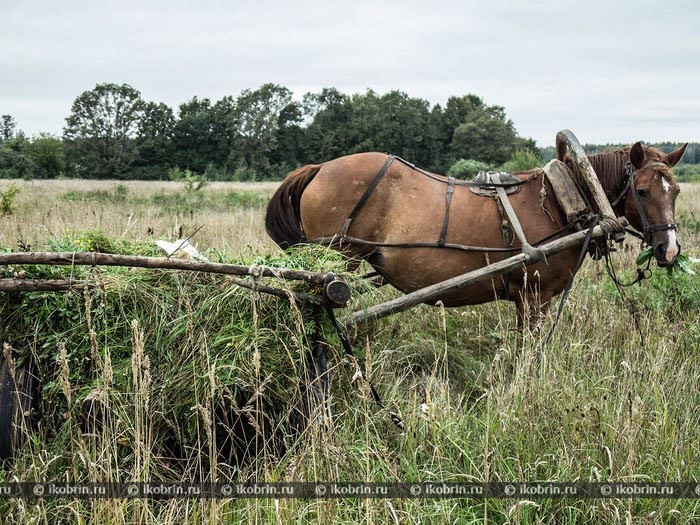
It is not enough that there are no horses and people for their training, and the harness is a one more almost unsoluble question. What collars on collective-farm horses? One rags! Sedyolki, podbryushnik and girths a collective-farm horse does not know in general. A breast-band – from a twine from a straw bale, the same bridle and reins. In such "dress" of a horse it is inconvenient and painful. And it is necessary to pull! The same and with the cart. If there are four wheels, then without rubber and if with rubber, then without air. Here so the collective farm applies for receiving cheap agricultural production. To me it is not ridiculous. To me it is painful. Painfully from a hopelessness...
And still the horse continues the immemorial work. Where with an overstrain, where "vpripryazhka". Today the head of any rank has to reflect and whether it is worth using powerful equipment and expensive fuel on transportation of small freights. But do not reflect yet.
Though the Brest regional executive committee nevertheless adopted recently the program for increase in a livestock of working horses in collective-farm and state-farm production. In Baranovichsky district there is a stud "World". "And horses this year, more than ever – magnificent" – the director Anatoly Kokash told me. In "World" draft Belarusian breed of horses. She is an unpretentious, tyagovity, small horse. It is convenient both in collective farms and on a personal farmstead. And spare parts with fuels and lubricants are not necessary. And it is necessary to feed, feed all live. Anyway the horse deserves to herself both respect, and gratitude. Times changed and it is time to tell: "Hello, horses!"
Shag newspaper, January, 2000.
Materials

Our partners
Communication with us
Help: +375(1642)22331
Accommodation: +375(1642)39371
Excursions: +375(29)2046305
Support: +375(29)8012472
Email: atlant_kobrin@tut.by
Email: admin@ikobrin.ru
Edition: to contact us
To advertisers


About our city
For tourists
Our projects: Tourist Kobrin | Intellectual Kobrin
All rights reserved © 2011-2015. All images are protected by their owners.
When copying materials the active reference to http://ikobrin.ru is obligatory.